
Standing on the test floor here at SHZK, the most common question I get from integrators is exactly how to select a VFD for their specific motor load. Getting this wrong means tripped breakers, overheated cables, or burnt IGBTs. This vfd sizing guide breaks down the real-world differences between G (General), P (Pump/Fan), and PV models, explains single-phase input derating, and shows you how to match by current using our 300N series nameplate data.
Decoding the 300N Naming Rule: G vs P Selection
When you look at the nameplate on our 55kW unit, the model reads 300N – 055 G B – T4. Let’s break down that naming rule from Chapter 1.2 of our manual so you know exactly what you’re buying.
- 300N: The product series lineup.
- 055: Power rating (55kW). Our range spans from 0.75kW up to 800kW.
- G: General purpose (Constant Torque). Designed for conveyors, extruders, and hoists.
- B: Includes a built-in braking unit. (Empty means no brake unit).
- T4: Voltage level (3PH 380-480V input / 3PH 0-480V output).
If your application is a centrifugal pump or a cooling fan, you don’t need the constant torque capability of the ‘G’ model. You would select the ‘P’ (Variable Torque) model. The ‘P’ model shares the same physical chassis but is optimized for lower continuous current demands typical in fluid dynamics. For solar water pumping, the ‘PV’ variant includes MPPT algorithms built directly into the drive logic.
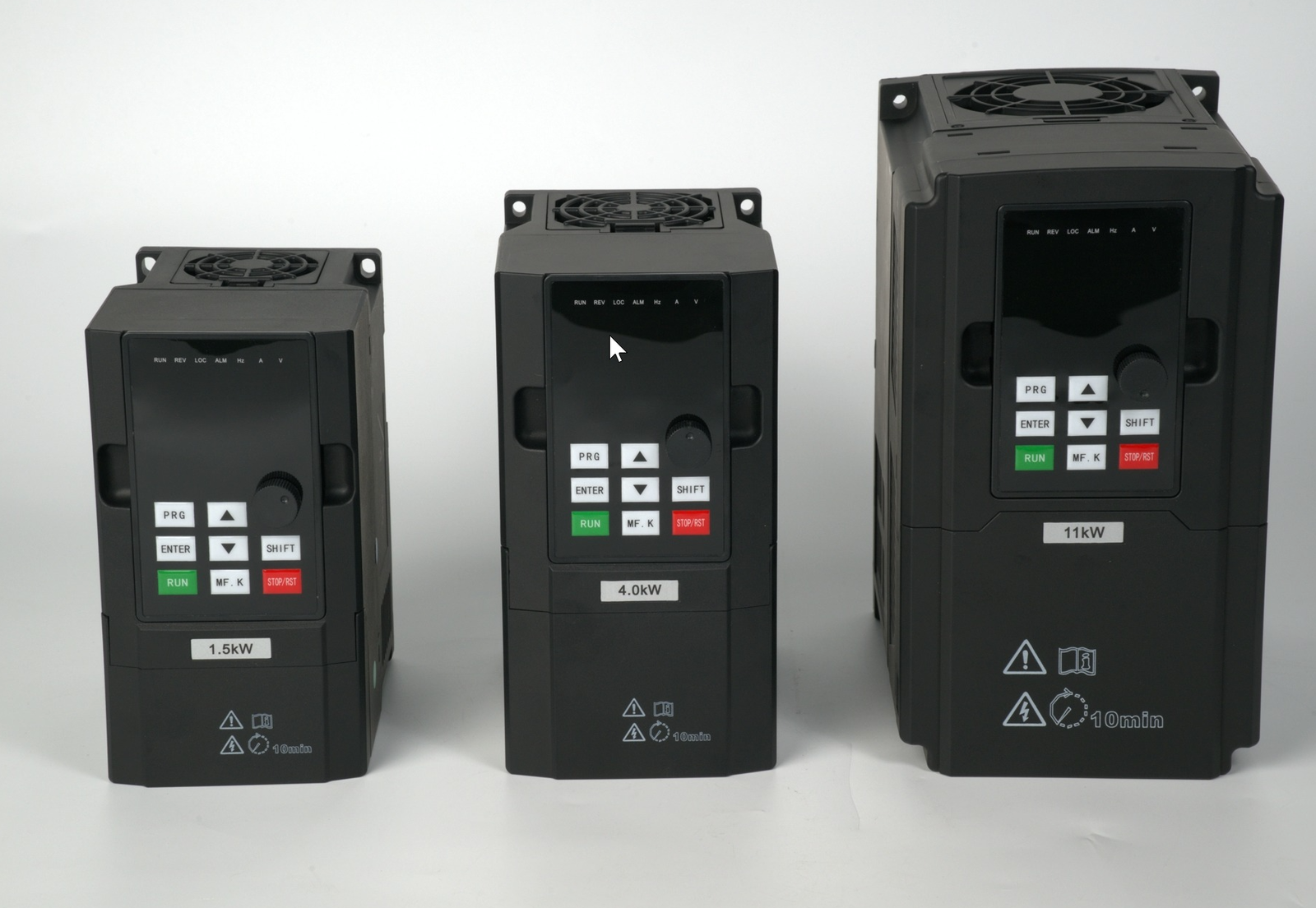
Quick Parameter Reference: Real Nameplate Data
Never size a drive by horsepower alone. Always verify the current ratings on the data plate. Here is the exact electrical data pulled directly from the 55kW T4 model we just tested on the line:
Input Voltage
3PH AC 380-480V
Input Current
106A @ 50/60Hz
Output Voltage
3PH AC 0-480V
Output Current
112A @ 0-500Hz
Notice the output current is 112A. If your motor’s full load amps (FLA) exceed 112A, this 55kW drive will trip on overcurrent. You must step up to the next frame size. The underlying theory of how these power stages handle current is well documented in resources like the Wikipedia article on variable-frequency drives, but on our shop floor, we just ensure the IGBT modules and heatsinks are sized to dissipate the thermal load of that 112A continuous draw.
Single-Phase Inputs & Current Matching

What if your site only has single-phase power? Our naming rule covers specific voltage levels for this. Look at the voltage level codes in the manual:
- S2: 1PH AC 200V-240V input / 3PH 0-240V output
- H2: 1PH AC 200V-240V input / 1PH 0-240V output
- S3: 1PH AC 220V input / 3PH 0-220V output
When feeding single-phase power into a drive designed for three-phase output (like the S2 model), the input rectifier diodes carry the entire load. This generates more heat. The golden rule here is to match by current, not kilowatts. If your 3-phase motor draws 15A, you need a single-phase input VFD rated for at least 15A on the output, which usually means upsizing the drive by one or two frame sizes compared to a standard 3-phase input application.
Wiring and Communication Setup
Once you’ve selected the right model and verified the current ratings, physical installation is next. Proper torque on the power terminals is critical to prevent hot spots. For control wiring, keeping analog signals shielded and separated from power cables prevents noise injection.
If you are integrating the drive into a SCADA system, our 300N series supports standard industrial protocols. The specifications defined by the Modbus Organization are fully implemented in our RTU mode, allowing seamless polling of our P-codes and b-codes for real-time monitoring.
Inside the enclosure, the separation between the high-power stage and the low-voltage control logic is strict. We use dedicated grounding points and physical barriers to ensure electromagnetic compatibility (EMC). When you open the cover, you’ll see the control board PCB mounted securely above the power stage, keeping sensitive microprocessors away from the switching noise of the IGBTs.

Quality Assurance on the Test Floor
Every drive that leaves our facility goes through a full burn-in test. We don’t just check if it powers on; we load it to verify thermal stability and parameter retention. Seeing the drives lined up on the aging racks gives us confidence that when you select a VFD from our 300N series, it will perform exactly as the nameplate specifies.

Need help selecting the right VFD? Contact our engineering team at mail@shzkvfd.com or WhatsApp +86 13757750205 for free application consultation.
Need help sizing? Use our 300N selection guide or browse all SHZK VFDs.