
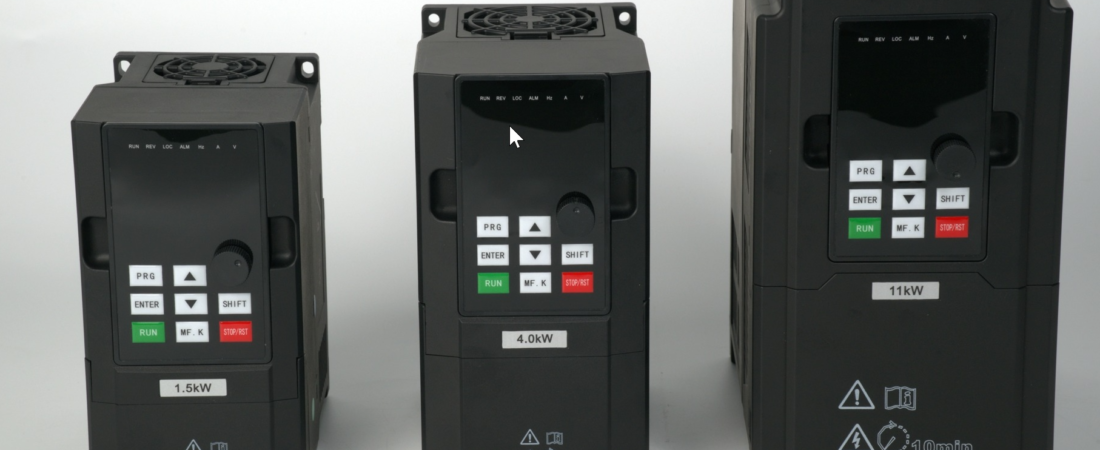
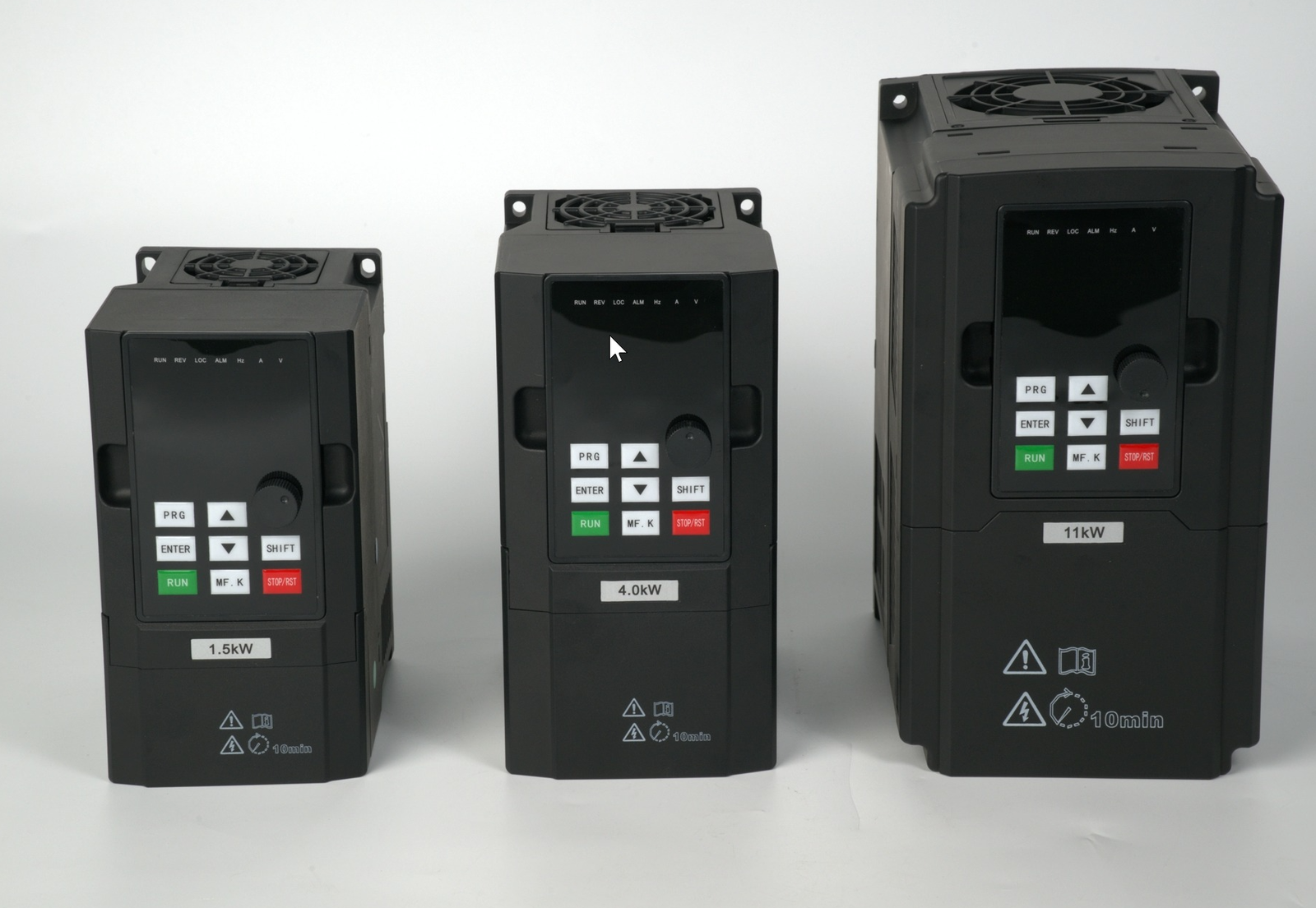
If you are sourcing a Schneider VFD alternative that matches Altivar performance without the brand markup, the SHZK 300N series is engineered for exactly that swap. On our production floor here at SHZK, we build and bench-test every 300N unit against the same load profiles that Altivar drives handle — pump loops, fan arrays, conveyor starts, spindle drives. The 300N is our direct Altivar alternative for 0.75 kW through 800 kW at 380–480 V 3-phase, and the parameter architecture maps closely enough that an experienced commissioning engineer can migrate an Altivar project in an afternoon.
This guide pulls real numbers from our 300N manual and our test logs. No marketing filler — just the parameters, the wiring, and the fault behavior you will actually see on the shop floor.
SHZK 300N at a Glance — What You Are Actually Buying
The 300N naming convention tells you everything you need before you open the box. Take a typical unit off our line: 300N-055GB-T4.
- 300N — product series
- 055 — 55 kW power rating
- G — general-purpose duty
- B — braking unit included
- T4 — 3-phase 380–480 V input / 0–480 V output
The data plate on every unit we ship reads:
- INPUT: 3PH AC 380–480 V, 106 A, 50/60 Hz
- OUTPUT: 3PH AC 0–480 V, 112 A, 0–500 Hz
- POWER: 55 kW
For comparison, a Schneider Altivar ATV320U55N4C covers the same 5.5 kW range (different model tier) while the ATV930 series handles the heavy industrial class. The 300N sits in the same general-purpose-to-heavy-duty envelope, with the T2 option covering 200–240 V and S2/H2 options for single-phase 200–240 V input.
Parameter-by-Parameter: Where the 300N Matches Altivar

Engineers switching from Altivar want to know one thing first: does the parameter set do what I need? The 300N PID group (PA codes) is where most process applications live, and here is what you get straight from the manual:
Quick Parameter Reference — PA Group (PID Function)
PA-00 — PID Source
Range: 0–7
Default: 0 (PA-01 setting)
Options: AI1, AI2, AI3 (ext. pot), HDI pulse (X5), Communication, Multi-step, Water supply pressure group
PA-01 — PID Given Value
Range: 0.0–100.0 %
Default: 50.0 %
Direct setpoint when PA-00 = 0
PA-02 — PID Feedback Source
Range: 0–8
Default: 0 (AI1)
Includes AI1-AI2 differential, AI1+AI2 sum, MAX/MIN of AI1 and AI2
PA-03 — PID Direction
Range: 0–1
Default: 0 (Positive)
0 = Positive effect, 1 = Negative effect
PA-04 — Setpoint/Feedback Range
Range: 0–65535
Default: 1000
Engineering unit scaling for HMI display
PA-05 — Proportional Gain KP1
Range: 0.0–100.0
Default: 20.0
Tune for loop stiffness
PA-06 — Integration Time Ti1
Range: 0.01–10.00 s
Default: 2.00 s
Eliminates steady-state offset
PA-07 — Differential Time Td1
Range: 0.000–10.000 s
Default: 0.000
Derivative action for fast disturbance rejection
For Schneider Altivar drives, the equivalent process PID parameters sit in the PID block of the SoMachine or EcoStruxure configuration. The 300N gives you the same P/I/D knobs at the keypad level without needing a software suite — which matters when you are commissioning on a ladder in a pump station.
Wiring and Terminal Layout
Migrating from an Altivar to a 300N on an existing panel? The terminal block arrangement follows the same logic you already know:
- Power input on L1/L2/L3 (R/S/T), motor output on U/V/W (T1/T2/T3)
- Analog inputs AI1, AI2, AI3 for speed reference and process feedback
- Digital inputs for run/stop, forward/reverse, multi-speed, fault reset
- Relay outputs for fault indication and run status
- HDI pulse input (X5) for flow meter or encoder feedback
The grounding stud, DC bus terminals, and brake resistor connection points are in the positions you would expect from a standard IGBT-based variable frequency drive. Our wiring diagram matches the terminal labeling on the enclosure door — no translation required.

What the Test Floor Tells Us

Every 300N that leaves our factory runs through a full load test on our bench — not a power-on check, a real loaded burn-in at rated current. We watch the IGBT module temperatures, the DC bus ripple, and the fan current draw. Units that drift outside tolerance get pulled before they reach the warehouse shelves.
This is where a factory-direct altivar alternative earns its keep. We see the thermal behavior of every power stage. When an Altivar equivalent claim comes from a trading company that has never opened the enclosure, you have no idea what is inside. When it comes from us, we can show you the test log with your serial number on it.
Power Stage Detail
Below is the power stage PCB of a 15 kW 300N unit — the same topology used across the range with scaled IGBT modules. Three-phase rectifier, DC bus capacitors, six-pack inverter module, and the gate driver board. This is the hardware that handles your 112 A output current on the 55 kW model.

Communication — Modbus RTU
If your SCADA or PLC talks to Altivar over Modbus RTU, the 300N speaks the same language. The register map covers speed reference, status words, fault codes, and all PA-group parameters. We follow the standard Modbus protocol specification for RTU framing — 8 data bits, 1 stop bit, no parity (or even parity, selectable), baud rates up to 115200. A polling system built for Altivar Modbus can usually be pointed at the 300N with a register address change and nothing else.
Pricing Reality — Factory Direct vs. Brand
A Schneider Altivar ATV320 or ATV630 at 55 kW carries a list price that includes distribution margins, brand positioning, and regional service network costs. The SHZK 300N at the same rating ships from our factory direct to your panel shop or end user. You are paying for the same IGBT power stage, the same PID control loops, the same Modbus register architecture — without the middlemen.
For a deeper breakdown of what you gain and what you trade when moving from a brand-name drive to a factory-direct unit, see our brand VFD vs. factory-direct comparison.
When the 300N Is the Right Altivar Alternative
Related Technical Guides
Need help selecting the right VFD?
Contact our engineering team at mail@shzkvfd.com or WhatsApp +86 13757750205 for free application consultation.